You finish a mix, you're proud of it, and then you play it right after a commercial track — and yours sounds quiet, small, and weak by comparison. The instinct is to grab a limiter and crush it until it's as loud as everything else. That instinct is half right and half a trap. Loudness is one of the most misunderstood parts of production, and once you understand how it actually works in the streaming era, you'll get a competitive, powerful master without destroying it.
Let's clear it up.
First: LUFS, and why "loud" isn't about peaks
There are two different ways to measure how loud audio is, and confusing them is where people go wrong.
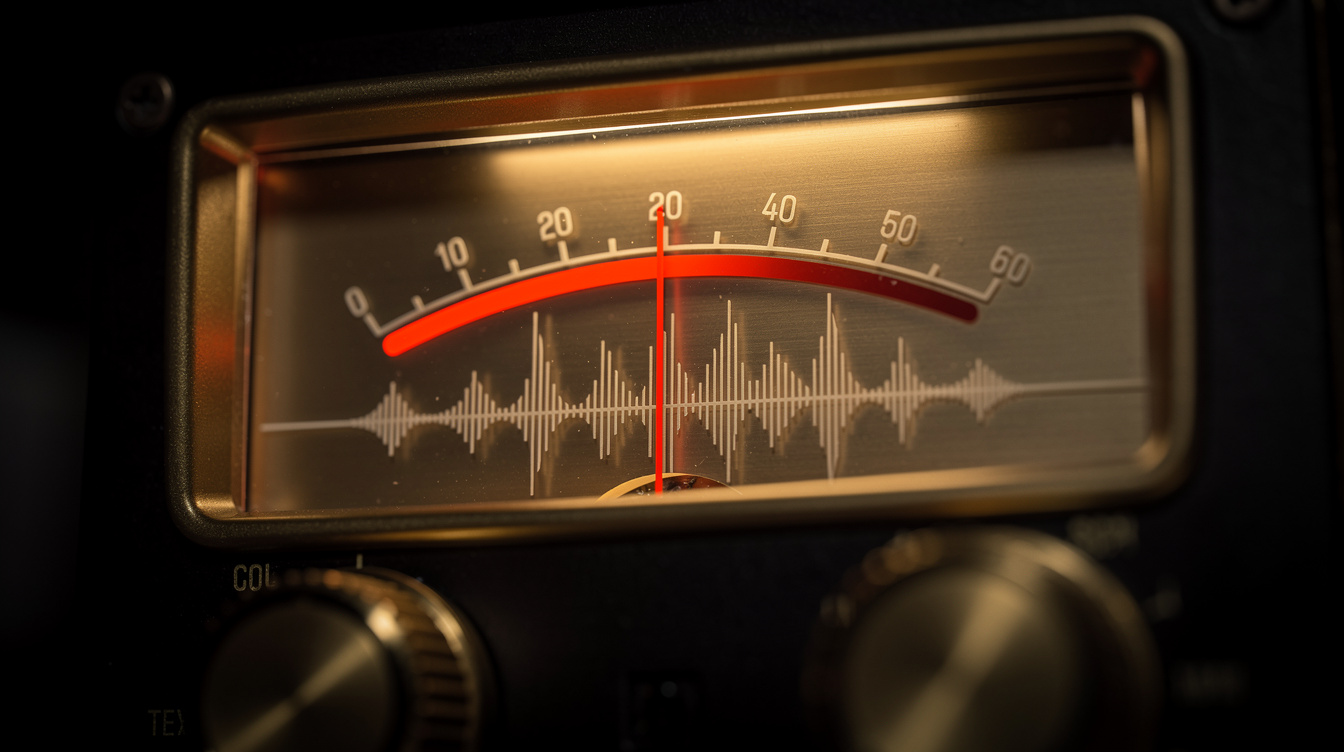
Peak level is the single highest instantaneous point of the waveform. LUFS (Loudness Units Full Scale) measures perceived loudness — how loud it actually sounds to human ears, averaged over time, accounting for how we hear different frequencies. LUFS is the one that matters for "why does mine sound quieter," because two tracks can have identical peaks but wildly different perceived loudness.
You make something perceived as louder not by raising the peaks (they're already near the ceiling) but by raising the average level — bringing the quiet parts up closer to the loud parts. And that's exactly where the danger is, because the crude way to do that is to squash all the dynamics out.
Chasing a loudness number is mostly pointless now
This is the part almost nobody told you, and it changes the whole game: streaming platforms normalize loudness.
Spotify, Apple Music, YouTube, Tidal and the rest automatically adjust every track's playback volume to a consistent target (roughly -14 LUFS for several platforms, around -16 for Apple Music) so listeners don't have to ride the volume knob between songs. What this means for you is enormous:
If you crush your master to be super loud, the platform just turns it back down. You don't win the loudness war — you can't, because the platform un-does your loudness on playback. All you're left with is the damage: the squashed dynamics, the lost punch, the fatigue. You paid the full price of brick-walling and got none of the benefit.
So the old goal — "be as loud as possible to stand out" — is dead for streaming. And "master to exactly -14 LUFS" is also a misunderstanding: normalization was never meant to force you to a specific number. The real goal is to make a master that sounds great and competitive at a sensible level — and then let normalization handle the rest.
How to get loud the right way
You still want a punchy, full, competitive-sounding master — quiet-and-weak is a real problem. You just achieve it through control, not destruction:
Fix loudness in the mix first. A mix that's already balanced, with a controlled low end (sidechain your bass to your kick) and even dynamics on the key elements, gets loud easily on the master. A messy mix can't be saved by a limiter. Most "my track is quiet" problems are actually mix problems wearing a mastering costume.
Use the limiter gently — and in stages. A limiter catches your peaks and lets you raise the overall level. The pro approach isn't one limiter doing all the work (that pumps and distorts) — it's gentle limiting, sometimes spread across two or three stages each doing a little, so the level comes up smoothly. In Onomo, the OnoLimiter on your master bus is the tool; ease it in rather than slamming it.
Set a true-peak ceiling below zero. Set your limiter's output ceiling to about -1.0 dBFS (some go to -2). This leaves a little headroom so your audio doesn't clip and distort when it's converted to lossy streaming formats. It's a small thing that protects your quality on the platforms.
Keep some dynamics alive. Aim to preserve real contrast between your loudest and average levels — a rough rule of thumb is leaving yourself at least 6–8 dB of dynamic range. A master with space and contrast hits harder than a flat, maximally-loud one, because the loud moments have somewhere to land. Dynamics are what make a track exciting; don't trade all of them for a number a platform will overrule anyway.
Use saturation to feel louder. A trick that adds perceived loudness without squashing: a touch of saturation adds harmonic content that makes a track sound richer, fuller, and louder to the ear at the same actual level. It's a way to get "bigger" without limiting harder.
The honest summary
Your mix sounds quiet because its perceived loudness (LUFS), not its peaks, is low — and the fix is to raise the average level with control, not to brick-wall it. And the freeing part: since streaming platforms normalize loudness, crushing your master to be maximally loud is pointless — they turn it back down and you keep only the damage. So stop chasing a loudness number. Get the mix balanced first, use the limiter gently (a true-peak ceiling around -1 dBFS, a few dB of limiting at most, in stages), keep real dynamics alive, and lean on saturation for perceived size. The result is a master that sounds loud, punchy, and alive on every platform — which is the only thing the loudness war was ever actually about.
FAQ
Why does my mix sound quieter than commercial songs? Because its perceived loudness (measured in LUFS) is lower — the average level is quiet even if the peaks are high. You raise perceived loudness by bringing the average up with limiting/compression, but the bigger fix is usually a cleaner, more balanced mix that gets loud easily.
Should I master to -14 LUFS for Spotify? Not as a hard target. Streaming platforms normalize playback loudness, so the goal isn't to hit a specific number — it's to make a master that sounds great and competitive at a sensible level. Don't crush your track to chase -14; the platform will just turn an over-loud master back down.
Does making a track louder make it sound better? Only up to a point. Past gentle limiting, "louder" trades away dynamics, punch, and clarity — and since platforms normalize anyway, you get the damage without the benefit. A controlled master with real dynamics sounds better than a brick-walled one that's technically louder.
What's a true-peak ceiling and what should I set it to? It's the maximum level your limiter allows, set to prevent clipping when audio is converted to streaming formats. Around -1.0 dBFS is a safe, common choice (some go to -2). It protects your sound quality on lossy platforms.
How do I make a track louder without crushing it? Balance the mix first (especially the low end), limit gently in stages with a true-peak ceiling, keep 6–8 dB of dynamic range, and use a touch of saturation to add perceived size. That gets you loud and punchy while keeping the life in the track.
Loud and alive is the goal — not loud at any cost. There's more from The Producer's Craft on the techniques behind a polished record.
Ready to try it yourself?
Onomo is a creative suite in your browser — a full DAW, a design editor, a video editor and a writing room. Free to start, nothing to install.
On your phone? Make your account now and open Studio later on a laptop, Chromebook or tablet. The free Toolkit works right here.
Master your track in OnomoOther product and company names mentioned here are trademarks of their respective owners. Onomo isn’t affiliated with or endorsed by them. Details about other products are accurate to the best of our knowledge as of the post date and may change.