Welcome to Modern Producer — a course about how music actually gets made now. Not the theory (we have a whole course for that), and not the stuff in textbooks. This is the craft you can only learn by making things in the modern way: sampling, sound design, sidechaining, mixing in the box, mastering for streaming, using AI tools, and releasing into a world of 120,000 new songs a day.
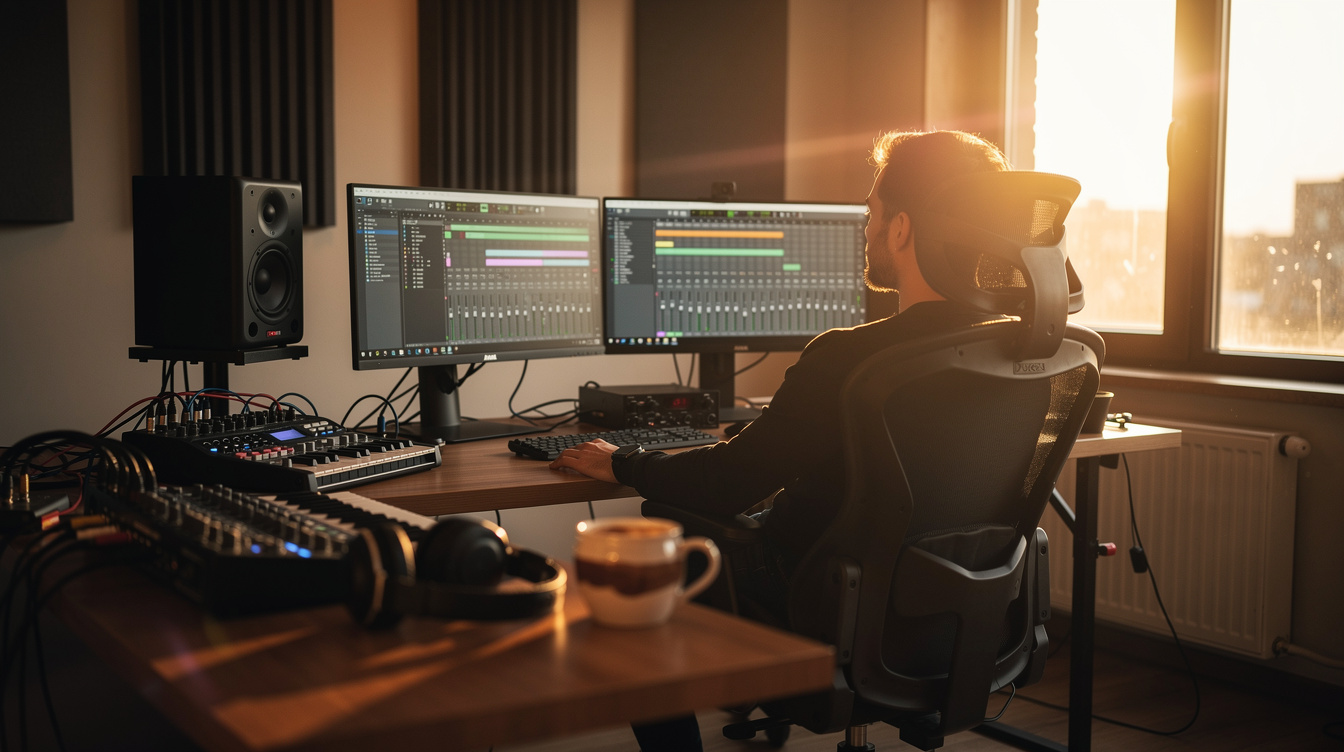
We start with the single idea that everything else rests on, and that trips up beginners coming from a "learn an instrument first" mindset: in 2026, the DAW is the instrument.
The shift that changed everything
For most of music history, to make music you had to physically play an instrument — years of practice before you could express a single idea well. That hasn't disappeared, but it's no longer the only path, and for huge swaths of modern music it isn't even the main one.
A DAW (Digital Audio Workstation) — the software you make music in — collapsed the whole production chain into one screen. Composing, recording, sampling, sound design, mixing, arranging, and mastering all happen in the same place. The result: the person who can't play piano can still make a stunning piano part by drawing notes into a piano roll, and the person who never touched a drum kit can program drums that hit harder than most live recordings.
This isn't cheating, and it isn't lesser. Entire genres — hip-hop, EDM, trap, lo-fi, hyperpop — were born in the DAW and couldn't exist without it. The DAW didn't replace musicianship. It created a new kind.
What "playing" the DAW actually means
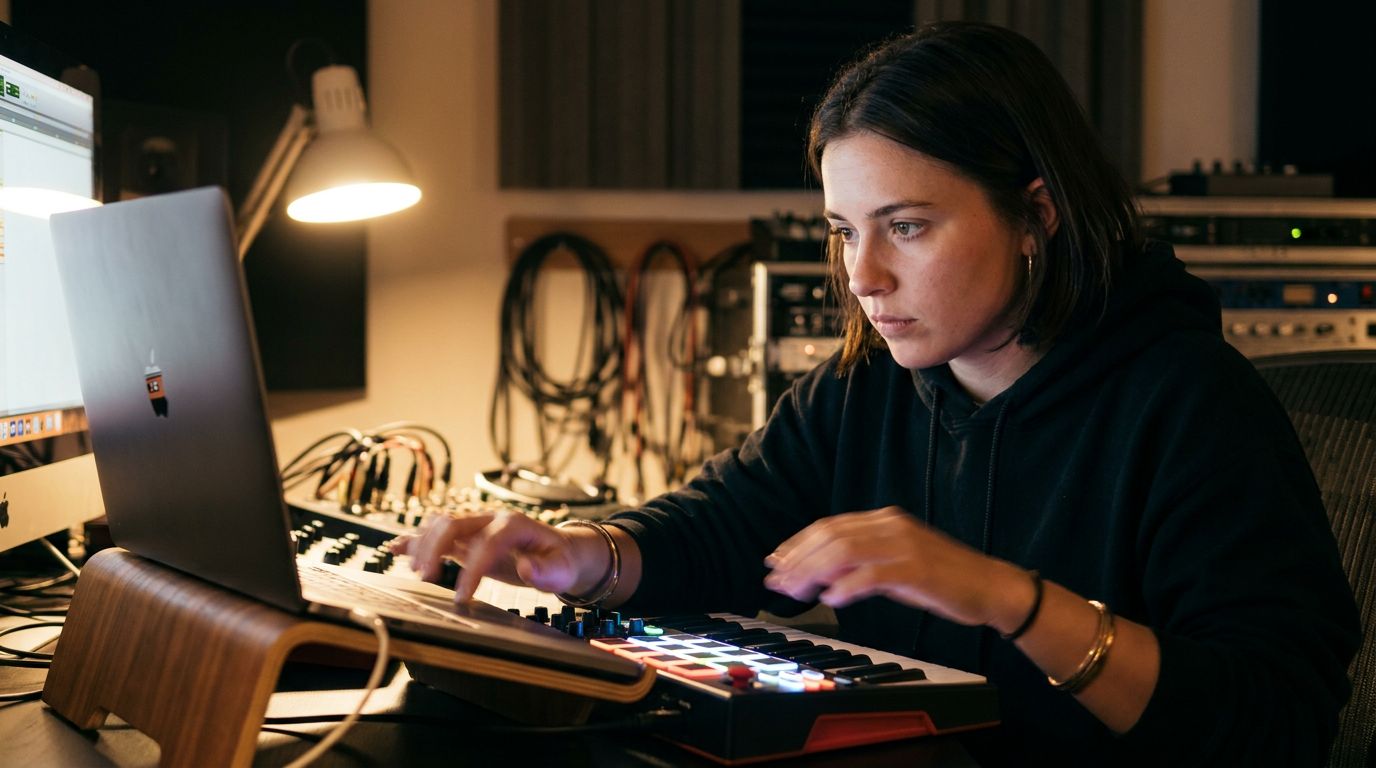
Treating the DAW as an instrument changes how you practice. You're not practicing scales on a keyboard — you're building speed and fluency in the tool. The producers who improve fastest are the ones who can get an idea down before they lose it, and that comes from knowing your DAW cold:
- Programming, not just performing — drawing drums, melodies, and basslines into the piano roll and step grid. The grid is your fretboard.
- Sampling and chopping — taking existing audio and turning it into something new (Lesson 2).
- Sound design — building or shaping the actual sounds, not just choosing presets (Lesson 3).
- Arranging — assembling sections into a song, dragging blocks around fearlessly because nothing is permanent.
- Mixing and processing — sculpting how it all sounds, all inside the same window (Lessons 5–6).
Fluency in these is what "good at the DAW" means. And like any instrument, it comes from reps — not from reading about it.
The superpower beginners overlook: nothing is permanent
The most freeing thing about the DAW as an instrument is that everything is non-destructive and editable. A wrong note isn't a wrong take — it's a note you drag one step over. A part that doesn't work gets muted, not re-performed. You can try a melody in five keys in thirty seconds. You can undo infinitely.
This removes the thing that paralyzes traditional musicians: the fear of the mistake. In a DAW, there are no mistakes, only versions. That changes how you should work — experiment constantly, commit to nothing, keep what sounds good. The cost of trying an idea is near zero, so try everything.
You don't need expensive gear (or any)
Another modern truth: the barrier to entry has collapsed. You don't need a studio, outboard gear, or a powerful computer. A capable DAW now runs entirely in a browser — no install, no plugins, free to start — which means the instrument is sitting in the tab you're reading this in. The gap between "I want to make music" and "I'm making music" is now about thirty seconds.
The gear conversation that consumes so many beginners is mostly a distraction. The pros make hits on the same software available to you. What separates them isn't equipment — it's fluency with the instrument and the number of songs they've finished.
What you actually need to remember
| Idea | The one-line version |
|---|---|
| The DAW is the instrument | Learn the software like a player learns an instrument. |
| It's a new musicianship | Programming, sampling, and sound design are real skills, not shortcuts. |
| Nothing is permanent | Experiment freely — there are only versions, never mistakes. |
| Fluency > gear | Speed in your DAW beats expensive equipment every time. |
This is the foundation for everything ahead. The DAW is where you'll sample, design sounds, mix, and master — so getting comfortable in it is lesson zero for all of it. The rest of this course is what to actually do with the instrument now that you see it as one.
Next: the technique that built hip-hop and powers a huge share of modern music — taking existing sound and flipping it into something new, legally. That's Lesson 2: Sampling and Flipping.
Best first step: open a browser DAW right now and place four kicks on the grid. You just played your new instrument. Keep going.
Ready to try it yourself?
Onomo is a creative suite in your browser — a full DAW, a design editor, a video editor and a writing room. Free to start, nothing to install.
On your phone? Make your account now and open Studio later on a laptop, Chromebook or tablet. The free Toolkit works right here.
Open the Studio and start playing