Picture this: you and two friends make a song in an afternoon. It's a vibe, everyone's happy, nobody talks about "ownership" because that would be weird. A year later it's got real streams and a sync offer, and suddenly everyone has a very different memory of who did what. Friendships end over this. Constantly.
A split sheet is the one-page document that prevents it entirely — and filling one out takes about five minutes on the day you finish the song. It's the single easiest way to avoid the ugliest, most relationship-destroying fights in music. Here's everything you need to know.
Heads up: general education, not legal advice. For high-stakes situations, have a music attorney review your agreements.
What a split sheet is
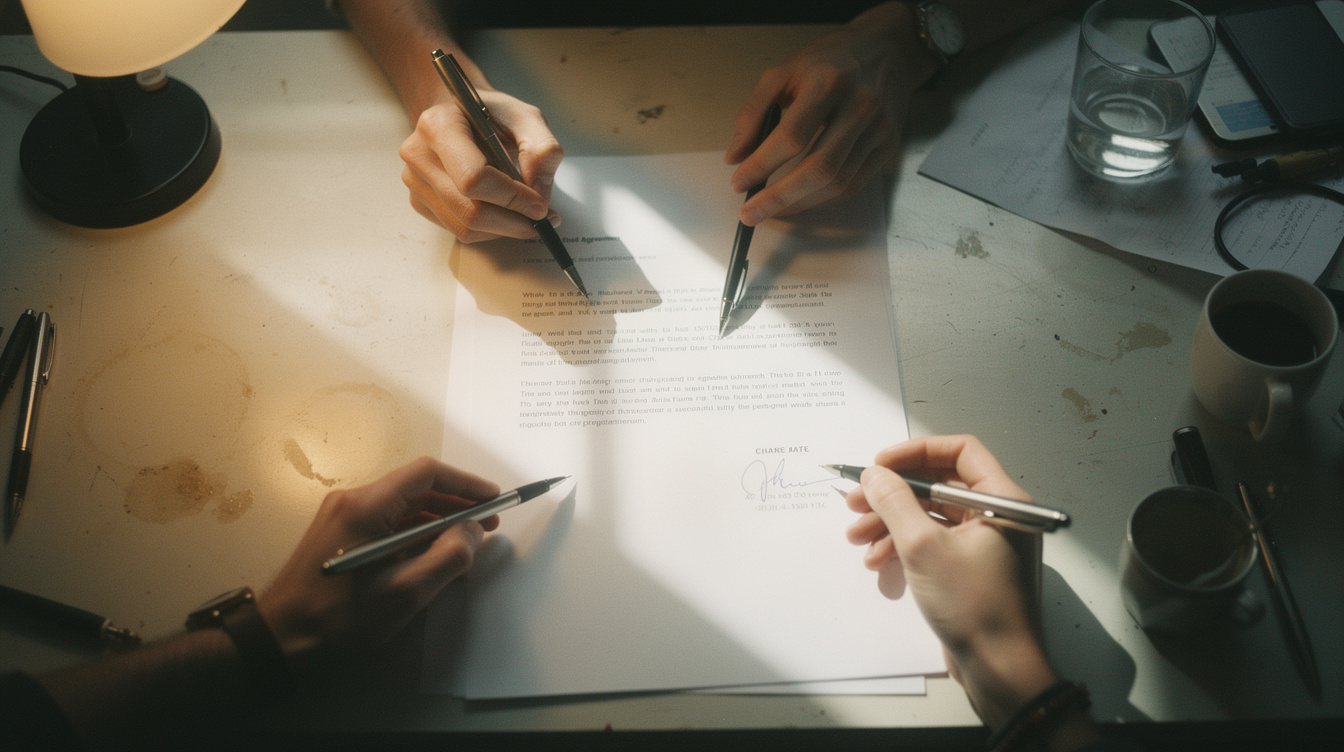
A split sheet is a simple written agreement, signed by everyone who contributed to writing a song, that states what percentage of the song each person owns. That's it. Names, contributions, percentages, signatures, date.
It becomes a legally meaningful document the moment everyone signs it. It's what your PRO and publishing collectors use to pay each writer their correct share. And it's the reference everyone points to when memories get fuzzy and money is involved.
Crucially, a split sheet covers the composition — the songwriting (melody, chords, lyrics). It does not automatically cover the master (the recording), which is a separate matter (more on that below). Keep that distinction in your head; it's where a lot of confusion lives.
Why you absolutely need one
What makes split sheets non-optional: if you don't have one, the law makes assumptions you might hate.
Under US copyright law, when a song is co-written without any written agreement, ownership defaults to being divided equally among all the contributors. Two people, no agreement? The law assumes 50/50. Three people? 33/33/33 — even if one person wrote the entire song and the other two just nodded along.
So "we'll just sort it out later" isn't a neutral choice. It's actively choosing the equal-split default, whether that reflects reality or not. If you wrote 90% of a song with two people in the room and never did a split sheet, you may have just legally given away most of your song. A split sheet is how you write down what actually happened before the law writes it down for you.
And the disputes it prevents are real and brutal — people who were friends suing each other, careers stalled because a song's ownership is contested and can't be licensed, collaborators quietly receiving less than they earned because nobody documented it. All avoidable with one page.
How splits actually work (the percentages)
A split sheet records each person's percentage of the songwriting, and all the percentages add up to 100%.
There's no rigid formula for who gets what — it's whatever the collaborators agree reflects their contribution. But a few common conventions help:
- The "equal split in the room" default. When people can't cleanly quantify who did what, many just split evenly among everyone who meaningfully contributed: two writers = 50/50, three = roughly a third each, four = 25% each. Simple, fair, drama-free — and a fine default when contributions were genuinely collaborative.
- Weighted splits when contributions clearly weren't equal — e.g., one person wrote all the lyrics and topline, another just added a small part. Agree on numbers that feel honest to everyone.
- Technically, splits have a writer's share and a publisher's share (each summing to 100%); for self-published indie artists these usually track together, but if a publisher is involved, note both.
The exact numbers matter less than the fact that everyone agreed to them in writing. A "wrong but agreed and documented" split causes zero fights. A "fair in your head but never written down" split causes lawsuits.
The producer question (this one's important)
Producers are where splits get genuinely murky, so be clear about it up front. The key question: did the producer contribute to the songwriting, or just provide the beat/recording?
- A producer who contributes to the composition — suggests a melody, writes a chord progression, shapes the arrangement, adds lyrics — has done songwriting and generally deserves a publishing split on the split sheet, just like any co-writer.
- A producer who only provided a beat (with no compositional input beyond it) is often handled differently — paid upfront for the beat, or via master royalties / a beat-lease agreement, rather than a publishing split.
And remember the master-vs-composition split: a producer might own 0% of the publishing but a percentage of the master, or vice versa. The split sheet handles the composition; the master ownership (who owns the recording, and any producer points on it) is a separate conversation you should also have. Don't assume one covers the other.
The fix for all of it is the same: talk about it explicitly, the day you make the song, and write down both the publishing splits and the master arrangement. Awkward for thirty seconds, priceless forever.
What to put on a split sheet
You don't need anything fancy — plenty of free templates exist. A solid split sheet includes:
- Song title
- Date it was written
- Each contributor's: legal name, stage name, role (writer/co-writer/producer), and contact info
- Each person's PRO and affiliation numbers (so royalties route correctly)
- Each person's percentage of the composition (totaling 100%)
- Signatures from everyone
- A note on the master arrangement if relevant
Fill it out, everyone signs, everyone keeps a copy. Done.
The bottom line
A split sheet is the cheapest insurance in music: one page, five minutes, filled out the day you finish a song, that prevents the most common and most relationship-destroying disputes in the industry. Without it, the law splits your song equally whether that's fair or not. With it, everyone gets exactly what they agreed to, the money routes correctly, and a hit never turns your collaborators into your adversaries. Make it a reflex on every song you don't write alone.
FAQ
What happens if I don't do a split sheet? US copyright law defaults to splitting a co-written song equally among all contributors, regardless of who actually did what. So skipping the split sheet means accepting that default — which can mean legally giving away far more of your song than you intended.
When should I fill out a split sheet? The day you finish the song, while everyone's still around and the stakes are zero. Agreeing on splits is easy before there's money involved and brutal afterward. Make it a normal end-of-session habit.
Does a split sheet cover the master recording too? No — a split sheet covers the composition (the songwriting). Who owns the master (the recording) and any producer points on it is a separate agreement you should also sort out. Don't assume one covers the other.
How should producers be credited? Depends on their contribution. A producer who helped write the song (melody, chords, arrangement, lyrics) typically gets a publishing split. A producer who only supplied a beat is usually paid upfront or via the master / a lease, not publishing. Decide and document it.
Do I need a lawyer for a split sheet? For a standard split sheet, a free template is usually fine. For higher-stakes situations — big collaborations, real money, complicated arrangements — having a music attorney review it is worth it.
One page now saves a lawsuit later. There's more Music Business 101 on royalties, publishing, and the rest of the business.
Ready to try it yourself?
Onomo is a creative suite in your browser — a full DAW, a design editor, a video editor and a writing room. Free to start, nothing to install.
More Music Business 101