The most-quoted number in the music business is also the most misleading: a Spotify stream pays roughly $0.003–$0.005. As of early 2026 that's about $4.43 per 1,000 US streams (TuneCore).
People see that and conclude "music doesn't pay." But a raw per-unit price tells you nothing without a comparison. A single grain of rice is worth nothing either — the question is always compared to what?
So let's build the comparison the doom-posts never do: an exchange rate. Take everything else you could earn from the same song, and price it in streams. The results are clarifying, and they point to a strategy, not despair.
A note on the numbers: figures below are 2026 industry ranges from sources cited inline (Bandcamp payouts, sync rate guides, indie-income breakdowns). Real deals vary enormously — a sync can be $500 or $50,000. The point is the order of magnitude of the exchange rate, which holds even at the low end.
The base rate: 1 stream ≈ $0.004
We'll use $4.43 per 1,000 streams as the unit, because it's the most recent published US figure. Everything below is converted into "how many streams would earn the same money."
Hold that number in your head: to earn one dollar from streaming, you need roughly 225 plays.
Before you convert anything: who actually gets the $0.004
That fraction of a cent doesn't land in one pocket — it splits, and where it splits determines whether you keep most of it or a sliver. Every recording is actually two separate copyrights: the composition (melody, chords, lyrics — owned by songwriters and their publishers) and the sound recording, the "master" (that specific recorded performance — usually owned by a label, or increasingly by the independent artist). Every stream pays both. (We have a full royalties primer too.)
Roughly how the royalty divides (Billboard's breakdown): the master owner takes ~80%, and the publishing/songwriting side takes ~20% (split about half into a mechanical royalty for the publisher/songwriter, half into a performance royalty collected by a PRO like ASCAP/BMI). The ~80% is the big one, and who gets it is everything:
- Signed to a label: the label keeps most of the master share and pays you a cut — a 20% artist royalty is common, which works out to roughly 16% of the total stream value reaching the artist, with ~64% going to the label.
- Independent, owning your master: you keep that whole ~80% (minus your distributor's small cut). The same hit song can pay its independent creator ~5x what it pays a signed artist on a standard deal — for the exact same stream. This is why "own your masters" is repeated like a mantra.
And some contributors get nothing at all: session musicians are almost always paid a flat one-time fee under a "work for hire" agreement, with no ongoing royalties — the guitarist on a song that streams a billion times often got a few hundred dollars, once. Producers typically do better, negotiating an upfront fee plus "points" (a backend royalty, often ~3–4% out of the artist's share) — but only if they negotiate it. Ownership, not contribution, determines the paycheck — so if you make your own music, you're the label, artist, songwriter, and producer at once, and when you collaborate, agree on splits up front.
With the chain clear, back to the exchange rates — every conversion below assumes you're independent and keeping the stream's value.
Exchange rate #1: one Bandcamp sale ≈ 200+ streams
On Bandcamp a fan pays roughly $7–$15 for an album, and after fees the artist nets somewhere around $0.85–$1 per dollar of that — call it $6–$12 in the artist's pocket for a typical album sale (Inspired by Beatz).
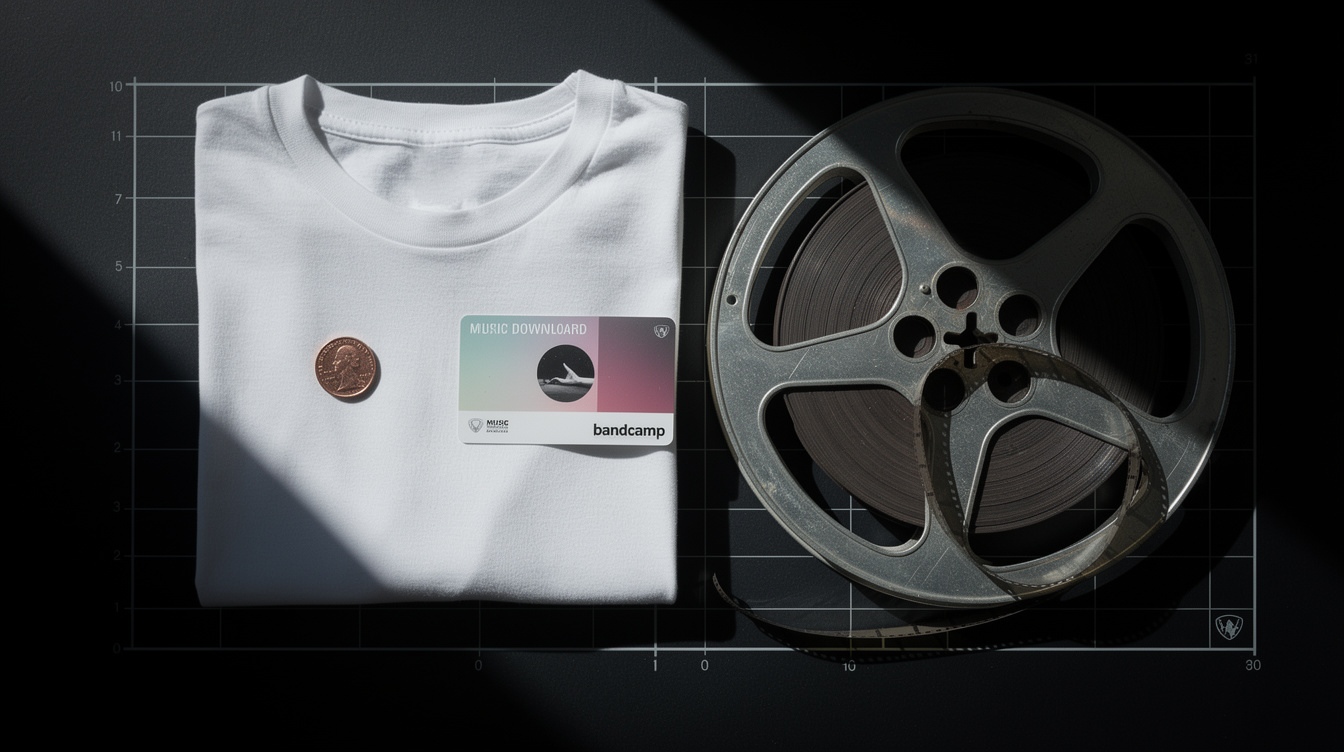
Convert it: a single $8 album sale ≈ 1,800 streams. One person choosing to buy your record is worth, in pure dollars, what nearly two thousand passive plays would earn you.
Exchange rate #2: one t-shirt ≈ 3,000+ streams
Merch is where the math gets stark. At shows, merch accounts for 30–60% of total revenue for mid-sized indie acts (Chartlex) — often the actual profit line of touring.
A band t-shirt sells for ~$25 and costs maybe ~$10 to make, netting roughly $15. Convert it: one t-shirt ≈ 3,400 streams. A $40 hoodie can clear 5,000+ streams' worth of margin. Sell ten shirts at a show and you've out-earned what most independent tracks make on streaming in a year.
Exchange rate #3: one sync placement ≈ 100,000+ streams
This is the one that breaks the scale. Sync licensing — getting your music into film, TV, ads, or games — pays, per placement (J.Scalco, industry rate guides):
| Placement type | Typical fee | ≈ streams to match |
|---|---|---|
| YouTube / branded content | $500–$5,000 | ~113,000–1.1M |
| Netflix-style series, per episode | $500–$5,000 | ~113,000–1.1M |
| National TV commercial | $5,000–$50,000 | ~1.1M–11M |
A single modest $500 sync ≈ 113,000 streams. One national ad placement can equal over ten million streams. A placement most listeners would never even notice can be worth more than a song accumulating plays for years.
The stat that ties it together
One number should reframe your whole strategy: in 2026, the average indie artist earned less than 10% of their total income from Spotify, Apple Music, and YouTube Music combined (Millennial Magazine).
Read that again. The metric everyone obsesses over — streams — is, for the typical independent artist, less than a tenth of the money. The other 90% is on Bandcamp, direct sales, sync, merch, and live. The doom-stat about per-stream rates is technically true and strategically irrelevant: streaming is the worst-paying way to monetize a song you already made.
None of this argues against streaming itself — it's discovery, it's reach, it's how people find you. It argues against measuring your career by it.
So what do you do with this?
The exchange rates point to one shift in thinking:
- Treat streaming as a top-of-funnel, not a revenue line. Its job is to turn strangers into fans. Fans are who buy the $8 album and the $25 shirt.
- Make things worth owning. The fan who buys is worth thousands of the listeners who skip. A great cover, a vinyl variant, a deluxe edition — these convert a stream into a sale, and a sale is worth ~1,800 streams.
- Chase placements, not just plays. One sync can dwarf a year of streaming. It's lumpy and hard to land, but the exchange rate explains why it's worth the effort.
None of this requires a label or a budget. It requires finishing music good enough that someone wants to own it — and then giving them something to own. The streaming number was never the point. It was the cheapest, lowest-value unit in the whole system, and now you know exactly how cheap: about 225 plays to the dollar.
Ready to try it yourself?
Onomo is a creative suite in your browser — a full DAW, a design editor, a video editor and a writing room. Free to start, nothing to install.
On your phone? Make your account now and open Studio later on a laptop, Chromebook or tablet. The free Toolkit works right here.
Make the song worth sellingOther product and company names mentioned here are trademarks of their respective owners. Onomo isn’t affiliated with or endorsed by them. Details about other products are accurate to the best of our knowledge as of the post date and may change.