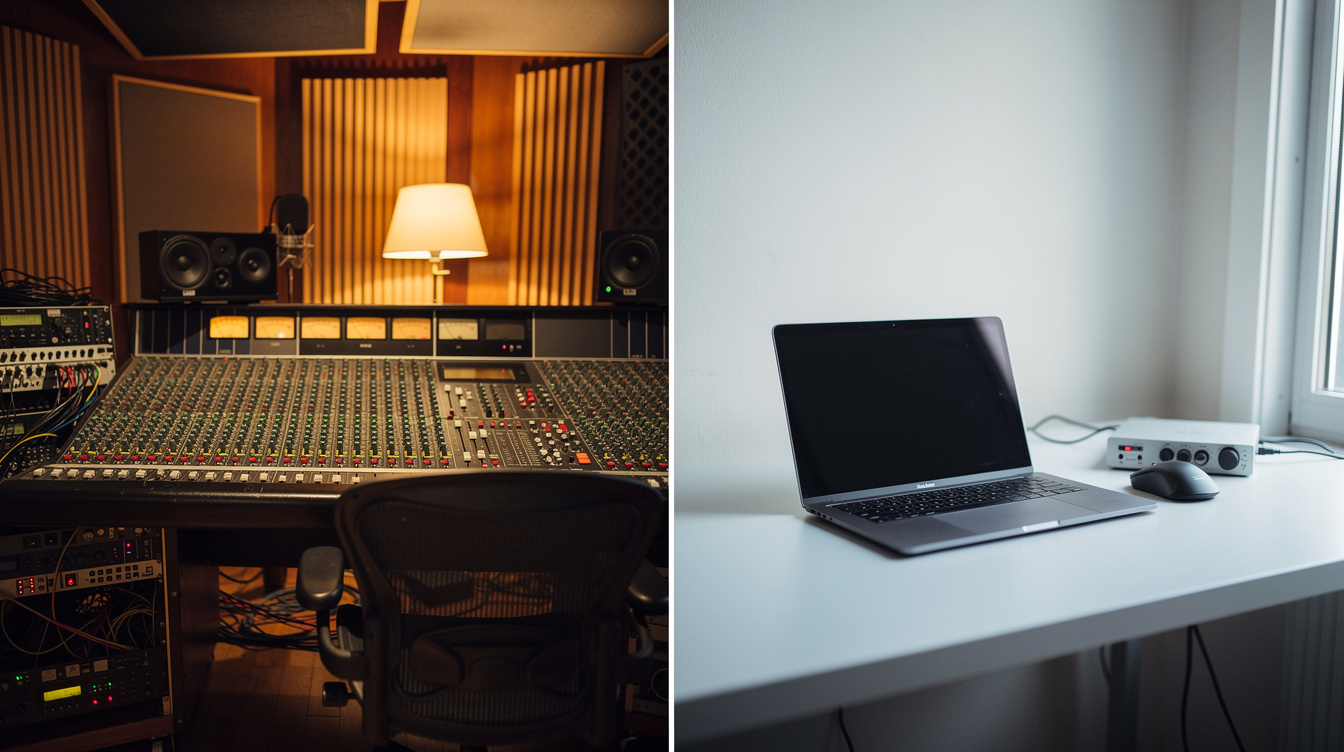
This is a comparison that should make every modern artist feel slightly giddy. The cost of making a professional-quality song has fallen off a cliff — not by a little, by orders of magnitude. What once required wealth, gatekeepers, and a small fortune now requires a laptop you already own. Let's actually trace where the money went, because the implications for you are huge.
1990: making a record was expensive and gatekept
To make a professionally-recorded song a few decades ago, you needed:
- A recording studio, which billed by the day — often hundreds to thousands of dollars per day, sometimes more for a top room. A real recording could run many days.
- An engineer and often a producer, paid professionals you couldn't do without.
- Expensive hardware — the mixing console, outboard gear, microphones, and instruments could cost as much as a house.
- Session musicians, hired by the hour, for parts you couldn't play.
- Physical manufacturing and distribution to get the finished record into stores.
The practical result: making a quality record cost thousands of dollars minimum, which meant you essentially needed a record label to fund it. That funding requirement is what gave labels their power — they were the bank, and the bank decided who got to make records. Cost was the gate, and labels held the key.
Now: the cost collapsed to ~zero
Fast-forward to today. To make a professional-quality song, you need:
- A computer you very likely already own.
- A DAW — and a capable one now runs free, in a browser, with no studio, no install, no hardware.
- That's basically it. Optional extras (a $100 mic, a MIDI keyboard, a subscription to a sample library) are cheap and entirely optional.
The studio, the console, the outboard gear, the manufacturing — all of it has been absorbed into software that's free or nearly free. A teenager with a laptop now has access to the entire production chain that used to require a building full of equipment and a label's checkbook. The barrier didn't just lower — for the core of making music, it essentially went to zero.
What collapsed alongside cost: the gatekeepers
This is the part that matters most. When making music cost a fortune, whoever held the money held the power — labels decided who got to record, who got heard, and who got a career. Cost was a filter, and the filter was controlled by a small number of companies.
When the cost collapsed, so did the gatekeeping. You no longer need anyone's permission or money to make and release a professional song. Distribution is cheap or free too, so the same democratization hit getting heard, not just making. The entire chain — make it, finish it, release it to the world — is now available to anyone, for nearly nothing.
What this actually means for you
Two things, and they cut in different directions:
The empowering part: there has never been a better time to be an independent artist. The tools that made hits are in your hands for free. You don't need to be chosen. You don't need money. You don't need permission. The single biggest historical barrier to making music — cost — is gone.
The honest part: when everyone can make music, everyone does — which is why 120,000 songs hit streaming daily. The bottleneck moved. It's no longer access (you have it) — it's finishing, quality, identity, and persistence. The gate didn't disappear; it moved from "can you afford to make it?" to "can you make something worth hearing, and keep showing up?" Those are skills, not bank balances — and that's a far fairer gate.
The takeaway
The collapse in the cost of making music is one of the great democratizations in creative history. The studio that cost a fortune is now a free tab. The label that held the purse strings is now optional. What's left between you and making music is no longer money — it's just the choice to do it.
So make the song. It's free now. That was the whole revolution, and it's already in your hands.
Ready to try it yourself?
Onomo is a creative suite in your browser — a full DAW, a design editor, a video editor and a writing room. Free to start, nothing to install.
On your phone? Make your account now and open Studio later on a laptop, Chromebook or tablet. The free Toolkit works right here.
Make a song for free in the Studio