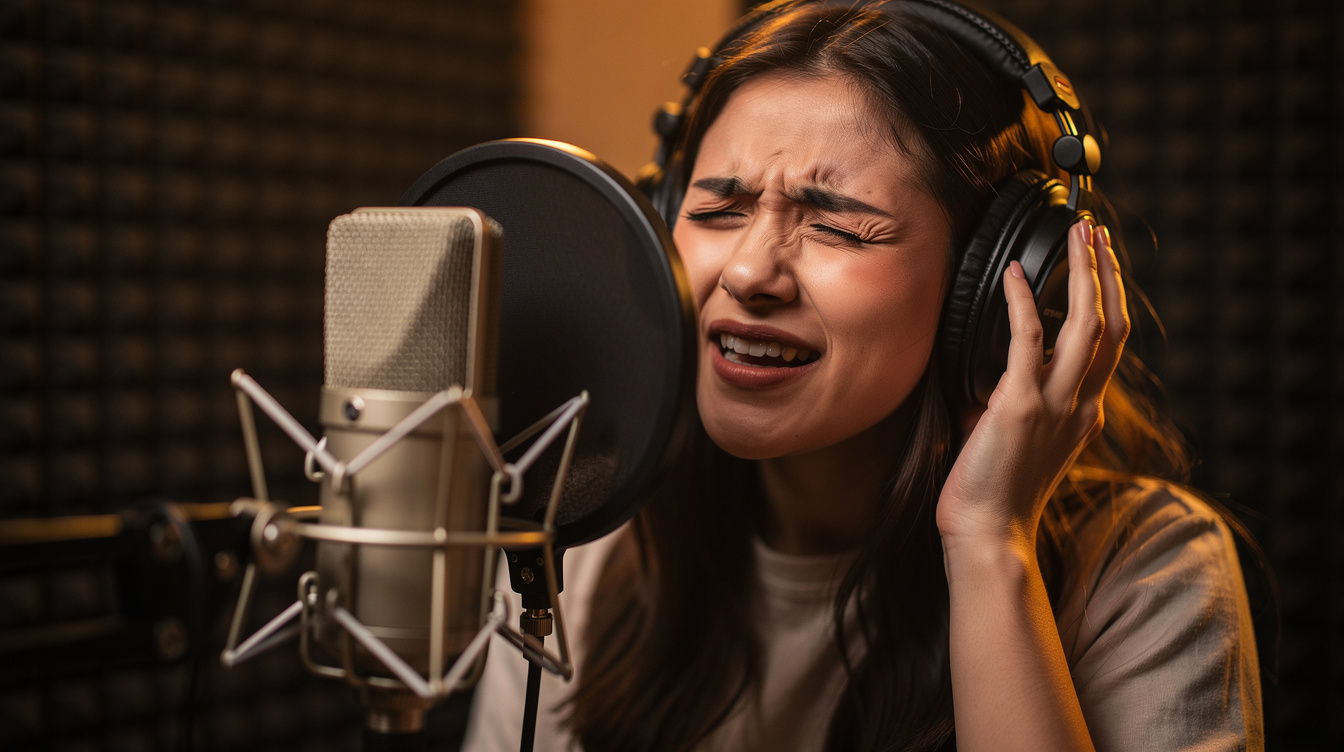
Almost everyone has had this moment: you record your voice — singing, rapping, even just talking — play it back, and recoil. "That's not what I sound like. That can't be me." It's one of the most universal cringe experiences there is, and for anyone who wants to make vocal music, it can be a real barrier. Good news: there's a clean scientific reason for it, the truth is reassuring, and getting past it is completely doable. Let's fix this.
Why it sounds so alien: two ways of hearing
When you speak or sing, you hear your voice through two paths at once:
- Air conduction — sound traveling out of your mouth, through the air, into your ears. This is the path everyone else hears, and it's the only path a microphone captures.
- Bone conduction — sound vibrating through the bones and tissues of your skull directly to your inner ear. This path is private to you. Nobody else gets it. A recording can't capture it.
Here's the key: bone conduction transmits lower frequencies especially well. So the voice you hear in your own head is richer, deeper, and fuller than your actual voice — your skull is adding bass that no one else hears. When you play back a recording, that bone-conducted bass is gone, and you hear only the air-conducted version — which sounds thinner, higher, and "wrong" compared to the bass-boosted version you've heard your whole life.
That's the whole mystery. Your recorded voice isn't distorted or fake — it's missing the secret bass your own skull was adding. The recording is more accurate to reality, not less.
Why this matters for making music
For a producer or artist, this isn't just trivia. The "I hate my recorded voice" reflex actively stops people from making vocal music. It causes:
- Avoidance. People who'd love to sing or rap never record because the playback makes them cringe — and they assume the cringe means they sound bad, when it really just means they sound unfamiliar.
- Misjudging your own takes. You might reject a perfectly good vocal because it "doesn't sound like you" — when it sounds exactly like you to everyone else.
- Confidence collapse. That recoil can spiral into "I have a bad voice," which is usually false — you have an unfamiliar-to-yourself voice.
How to make peace with it
This is a known, beatable hurdle. What works:
1. Understand it's an illusion of familiarity, not quality. Just knowing the bone-conduction reason reframes the cringe. You're not hearing a flaw; you're hearing the absence of your skull's bass. That alone takes much of the sting out.
2. Record yourself a lot. Familiarity is the real cure. The more you hear your recorded voice, the more it becomes "normal" and the cringe fades. The artists comfortable with their voice aren't blessed with better voices — they've just heard themselves recorded hundreds of times until it stopped being weird.
3. Remember everyone feels this. Singers you idolize almost certainly cringed at their early recordings too. It's universal, including among the pros. You're not uniquely cursed.
4. Focus on the performance, not the timbre. What makes a vocal compelling is emotion, conviction, and delivery — not whether it matches the bassy version in your head. Plenty of beloved, iconic voices are technically "imperfect"; they connect because of feeling. (Production can polish the rest.)
The bigger lesson
This little science lesson is really about a bigger artist truth: your perception of yourself is not other people's perception of you — and yours is often the harsher, more distorted one. You hear flaws (and missing skull-bass) that nobody else notices or cares about. The recording is closer to the truth than the cringe is.
So don't let "I hate my recorded voice" stop you from making vocal music. That voice is the real you, the one people already know and accept. Record it, get used to it, and put it out into the world. The only person who ever found it strange was you — and now you know why.
Hit record. It sounds more like you than you think.
Ready to try it yourself?
Onomo is a creative suite in your browser — a full DAW, a design editor, a video editor and a writing room. Free to start, nothing to install.
On your phone? Make your account now and open Studio later on a laptop, Chromebook or tablet. The free Toolkit works right here.
Record your voice in the Studio