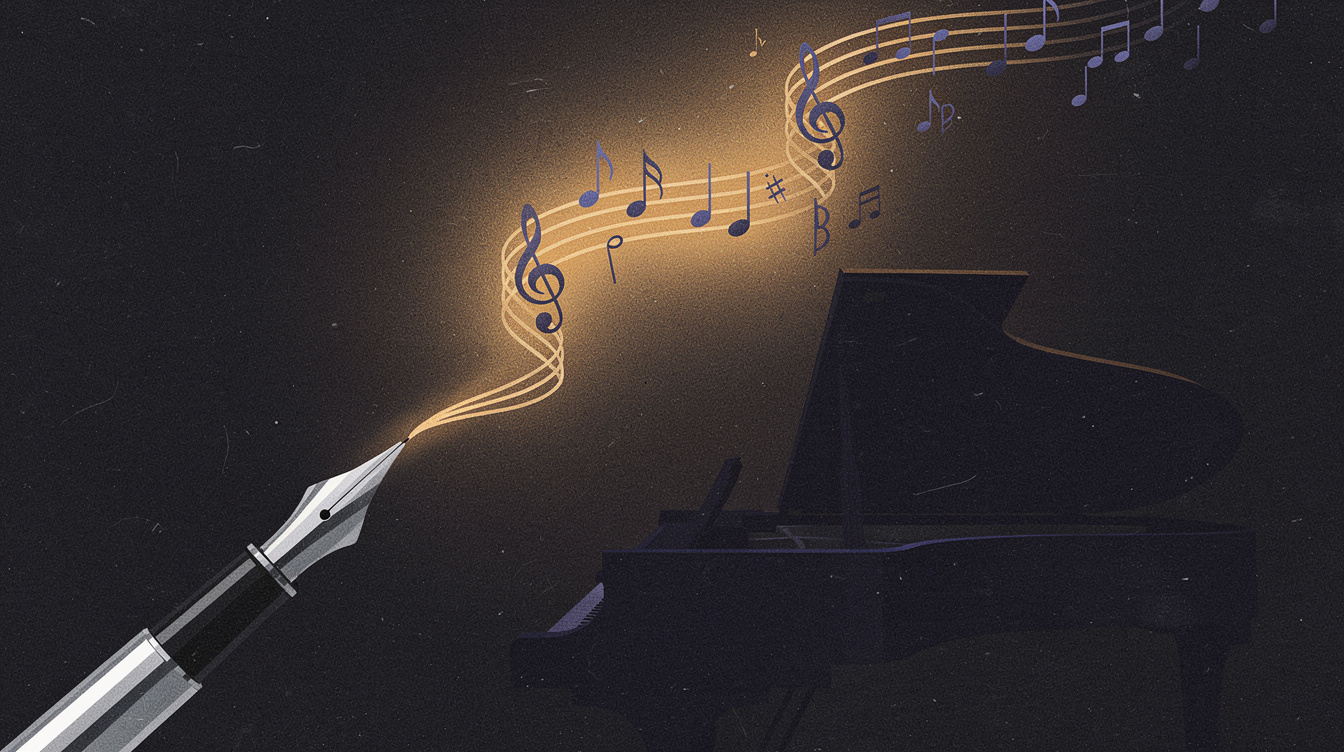
This is the finale of Fundamentals. You started knowing nothing but "there are notes", and you now understand scales, intervals, chords, progressions, and the map that connects them. There's one piece left — and it's the one your listeners will actually walk away humming: the melody.
The encouraging part: you already have everything you need to write one. A melody isn't a separate magic skill bolted onto theory. It's just the concepts you've already learned, used one note at a time.
What a melody actually is
A melody is a sequence of single notes played one after another — the "tune," the part you'd sing. Where chords (Lesson 5) stack notes vertically (at the same time), a melody lays them out horizontally (across time). It's the lead vocal, the topline, the hook, the riff.
And it draws on two things you already own:
- Its notes come from your scale / key — so they're guaranteed to fit.
- Its timing comes from rhythm and the grid — when each note lands is half of what makes a melody catchy.
That's the foundation. A melody is just your key's notes, arranged in time. Everything below is how to make that arrangement good.
The cheat code: melody notes that fit your chords
Want a melody to sound "right" instantly? Lean on this: when a chord is playing, notes from that chord will always sound consonant and strong over it. So if your progression is on a C chord (C-E-G), landing your melody on a C, E, or G during that bar sounds resolved and intentional.
The notes between chord tones (the other scale notes) are passing notes — great for movement and color, but they create a little tension that wants to resolve onto a chord tone. The art of melody is basically this dance: passing notes for motion, chord tones for landing. Tension and release again — the same principle from Lesson 4 and Lesson 6, now one note at a time.
Three things that turn notes into a memorable melody
Notes that merely fit can still be boring. What makes a melody stick:
1. Contour — the shape. A melody has a shape as it rises and falls. Great melodies usually have an arc: they build up to a high point (often the emotional peak of the hook) and resolve back down. A flat melody that hovers on one note is forgettable; one with a clear rise and fall tells a story. Think of the melody's silhouette, not just its notes.
2. Rhythm — the timing. This is the most underrated half. The same notes with a boring, on-the-grid rhythm fall flat; with a syncopated, breathing rhythm (Lesson 2) they become a hook. And crucially: leave space. Beginners cram melodies with too many notes. The gaps — the rests — are what make the notes you do play memorable. Silence is part of the melody.
3. Repetition — the memory. Catchy melodies repeat. A short idea ("motif") that comes back — maybe slightly varied each time — is what lets a listener learn the tune and sing it back. Repetition with small variation is the engine of nearly every hook you've ever had stuck in your head. Don't fear repeating yourself; it's how memory forms.
The whole course, in one picture
Step back and see what you've built. Every piece connects:
| Lesson | What it gave you | How it feeds melody |
|---|---|---|
| 1 — Notes | The 12 notes, octaves | The raw material |
| 2 — Rhythm | The grid, timing, groove | When melody notes land |
| 3 — Scales & Keys | A 7-note palette + a home | Which notes are safe |
| 4 — Intervals | Distance = emotion | Why melodic leaps feel a certain way |
| 5 — Chords | Stacking thirds into moods | Chord tones = melody's landing spots |
| 6 — Progressions | Chords moving over time | The harmony your melody rides on |
| 7 — Circle of Fifths | The map of it all | Where everything sits and relates |
| 8 — Melody | Notes in time, shaped | The part people remember |
These aren't eight separate topics. They're one system that builds on itself. Notes become intervals, intervals become chords, chords become progressions, and a melody is single notes weaving through all of it. The "mystery" of music is mostly just this chain, learned one link at a time.
The most important thing: now go use it
One last thing. Theory is a tool, not a test, and knowing it changes nothing until you make things with it. The producers who improve aren't the ones who memorize the most; they're the ones who finish the most songs, applying a little theory each time until it becomes instinct (the research on this is clear and encouraging).
So don't re-read this course five times. Open a project. Pick a key. Drop in a I-V-vi-IV progression. Hum a melody over it and find the notes. Make something — finish it, even if it's rough — and you'll learn more in that one session than in a week of reading. (If finishing is your sticking point, we wrote a whole guide on how to actually finish songs.)
You came in not knowing what a note was. You're leaving able to build a song from first principles. That's the entire foundation — everything else in music is a variation, an exception, or a deeper layer on top of what you now know.
Go make something. That was always the point.
That's the full Fundamentals course. Start from the top any time at Lesson 1: What Music Is Made Of, or browse the whole Fundamentals series.
Ready to try it yourself?
Onomo is a creative suite in your browser — a full DAW, a design editor, a video editor and a writing room. Free to start, nothing to install.
On your phone? Make your account now and open Studio later on a laptop, Chromebook or tablet. The free Toolkit works right here.
Write your first melody in the Studio