Say "808" to anyone who makes music today and they know exactly what you mean: that deep, booming, sub-bass kick that anchors hip-hop, trap, pop, and half the songs on the radio. The word has become so generic that a whole generation uses "808" to mean bass itself — "drop the 808," "my 808s are knocking."
The part almost nobody knows: the machine that started it all was a complete commercial failure. It sold poorly, got discontinued after three years, and was built around a manufacturing defect. It is, by a wide margin, the most successful flop in the history of music technology, and its story is one of the best in all of pop.
A machine built on broken parts
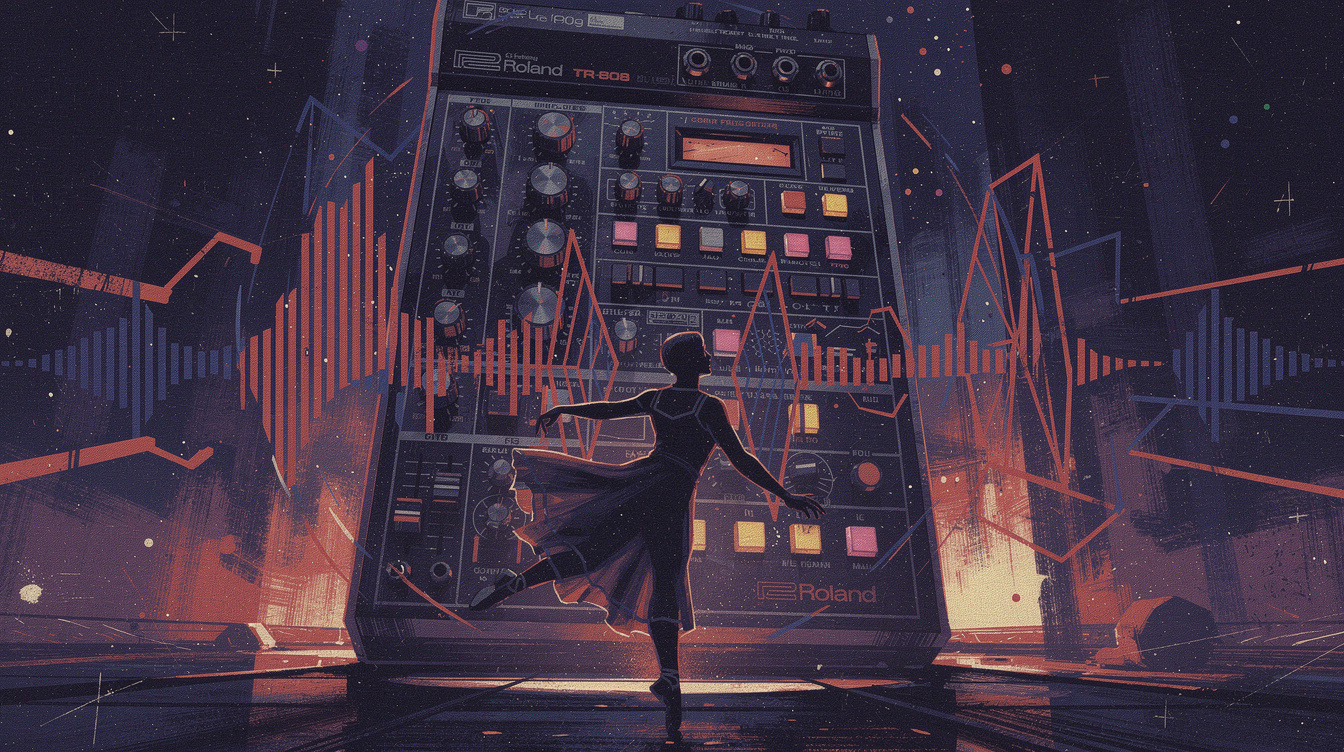
In 1980, the Roland Corporation released the TR-808 Rhythm Composer, a drum machine that let you program beats by lighting up a grid of buttons (sound familiar? that step-grid is the direct ancestor of the one in every DAW today). It cost about $1,195 — serious money at the time (Wikipedia).
And the delicious technical detail: a key part of the 808's distinctive sound came from faulty transistors. Roland had acquired a batch of semiconductors that didn't meet spec — they generated a particular kind of noise — and that "flaw" was exactly what gave the 808 its warm, idiosyncratic analog character, especially that famous bass drum (Smithsonian). The machine's magic was, quite literally, a defect that engineers would normally throw away.
Why it flopped
The 808 arrived at the wrong moment for its own sound. In 1980, the holy grail in drum machines was realism — producers wanted something that sounded like a real drummer. The 808 sounded nothing like a real kit. Its claps were too synthetic, its snare too thin, its kick a cartoonish boom. Critics and pros largely dismissed it as a toy. A competing machine that used actual recorded drum samples soon made the 808 look even more artificial by comparison.
So it sold badly. And in 1983, after producing only about 12,000 units, Roland pulled the plug — not just because of weak sales, but because semiconductor manufacturing had improved to the point where they could no longer source the "bad" transistors the sound depended on (Red Bull). The defect that made it special had been fixed out of existence. The 808 was, by every business measure, dead.
Then the wrong people found it
Here's where it turns. Those 12,000 unwanted machines flooded the used market at rock-bottom prices. And a very different crowd from Roland's intended customers picked them up: broke, experimental, underground musicians — hip-hop producers in the Bronx, electro and dance pioneers, R&B innovators — who didn't want realistic drums. They wanted something new, cheap, and futuristic. The 808's "fake," booming, otherworldly sounds weren't a bug to them. They were the whole point.
Two records in 1982 flipped the script:
- Marvin Gaye, "Sexual Healing" — the first US hit single built on the 808. It hit #3 on the Billboard Hot 100 and proved the machine could carry a massive mainstream song (Songfacts).
- Afrika Bambaataa & Soulsonic Force, "Planet Rock" — which used the 808 to create strange, futuristic percussion that detonated in clubs, sold over half a million copies, and effectively invented the template for hip-hop and electronic production for the next forty years (Wikipedia).
From there it never stopped. The 808 became the rhythmic backbone of hip-hop, Miami bass, Detroit techno, synthpop, and eventually trap and modern pop. It's been used on more hit records than any other drum machine ever made — a piece of gear so foundational that historians compare its impact to the Fender Stratocaster in rock.
Why it actually took over
Strip away the romance and there are real reasons a "failed" machine conquered music:
- It didn't sound real — and that became the aesthetic. Once listeners' ears adjusted, the 808's synthetic punch sounded modern, not cheap. Genres grew up around the sound itself.
- That bass drum. The 808 kick can be tuned down into pure sub-bass — a long, booming low note that doubles as both the kick and the bassline. That's the "808" people mean today, and it's perfect for systems built to be felt in the chest: car subs, club rigs, earbuds with bass boost.
- It was cheap and simple. Affordability and an easy step-grid put it in the hands of exactly the people who'd reinvent music with it — not the established studios who could've afforded anything.
- It was distinctive. In a world chasing realism, the one machine that sounded like nothing else turned out to be unforgettable.
The lesson hiding in the story
The 808's history is a strange little parable for anyone making music. The machine "failed" because it didn't sound like what everyone thought they wanted. It succeeded because a handful of people heard its imperfections as a new sound rather than a broken one — and built something nobody had heard before.
There's something freeing in that. The 808 wasn't polished or realistic or expensive. It was weird, cheap, and flawed — and it ate the world. The next time you worry that your sound is too odd, too lo-fi, or too "not like the pros," remember: the most influential drum machine in history was a discontinued flop built on broken parts. The flaw was the feature.
Go make something that sounds like you. The 808 would approve.
Ready to try it yourself?
Onomo is a creative suite in your browser — a full DAW, a design editor, a video editor and a writing room. Free to start, nothing to install.
On your phone? Make your account now and open Studio later on a laptop, Chromebook or tablet. The free Toolkit works right here.
Make an 808 beat in the Studio